Should You Build Your Own Business Website or Hire a Web Designer?
A do-it-yourself website can be the right move for a small business. So can hiring a professional web designer. The expensive mistake is choosing based only on the price shown on a website-builder signup page or the total in a design proposal.
The real decision is about time, complexity, control, and risk. A simple site for a new one-person business has different requirements from a site that must rank for competitive services, qualify leads, accept payments, connect to scheduling software, or preserve years of search visibility. The best option is the one that fits the job the website must do.
This guide compares the two paths in practical terms. It will help you decide what you can reasonably build yourself, when professional help is worth paying for, and what to prepare before you commit to either approach.
Start with the job, not the platform
Business owners often begin by comparing WordPress, Wix, Squarespace, Shopify, or another platform. That skips a more important question: What must the website accomplish for the business?
A website that only needs to confirm that a business exists, explain three services, and provide contact information is a manageable first project for many owners. A website expected to become a consistent source of qualified leads needs more planning. It may require service pages, location pages, conversion-focused forms, analytics, technical search setup, and a process for ongoing improvement.
Write down the website's required jobs before choosing how it will be built. Useful questions include:
- Who needs to find the website, and what will they be searching for?
- What information must a visitor understand before contacting the business?
- Does the site need forms, scheduling, payments, products, memberships, or other connected systems?
- Who will update the site after launch?
- What would happen if the site were broken, unavailable, or difficult to change?
If you are still defining the basic offer, a focused starter site may be enough. OHS Publishing's startup website planning page shows how a smaller launch can create a useful foundation without pretending every business needs a large site on day one.
When building your own website makes sense
DIY is not automatically the cheap or amateur option. It can be a sensible business decision when the scope is controlled and the owner has enough time and patience to learn the system.
The website is small and the offer is simple
A consultant with one clear service, a new local business testing an idea, or a temporary event may need only a few pages. If the content is ready and the path to contact is straightforward, a quality template can shorten the build considerably.
The key is discipline. A five-page project becomes difficult when every page adds new layouts, plugins, animations, and special features. A DIY project works best when you choose a practical structure and resist turning the site into a software-development project.
You have time to learn more than the editor
Building pages is only one part of launching a website. You also need to handle the domain, hosting, forms, mobile presentation, basic accessibility, page titles, image sizes, backups, security, and analytics. None of those tasks is impossible, but together they create a real learning curve.
If you enjoy technical work and can set aside uninterrupted time, that learning may be valuable. If every hour spent troubleshooting the website replaces an hour that should have gone to customer work, sales, or operations, the apparent savings can disappear quickly.
You accept a smaller first version
A useful first website does not need every feature on the wish list. You can launch the essential pages, confirm that forms work, and add carefully chosen improvements later. The new business website launch checklist provides a practical review for that first version.
When hiring a web designer is the better decision
Professional help becomes more valuable as the business consequence of a weak decision increases. The designer is not only arranging colors and sections. The work may include organizing the offer, planning the navigation, shaping calls to action, building reusable page systems, configuring the platform, and preparing the site for search and future maintenance.
The website needs to generate qualified leads
A lead-generation site must do more than look credible. It has to connect the visitor's question to the right service, explain why the business is a reasonable choice, and make the next step clear. That requires decisions about content, page order, proof, forms, and follow-up.
For example, a contractor may need separate pages for roofing, siding, and gutters, plus service-area information and a quote form that collects enough detail to route the inquiry. A single “Services” page and a generic contact form may be easier to build, but it asks the visitor and the sales team to do too much work.
The business competes in search
Search visibility is affected by what pages exist, how clearly each page addresses a topic, how the pages link together, and whether search engines can crawl and understand the site. SEO cannot be added effectively by installing a plugin at the end of a poorly planned build.
A professional build should create a sensible search foundation. That includes useful headings, descriptive page titles, internal links, mobile-friendly layouts, crawlable navigation, and a plan for redirects when old URLs change. Ongoing search work is a separate service, but the website should not make that work harder.
The site has important integrations or transactions
Scheduling, online payments, e-commerce, memberships, gated content, customer portals, and outside software connections add technical and operational risk. A feature can appear to work during setup and still fail in an edge case, send incomplete information, create duplicate notifications, or confuse customers on a phone.
If a broken feature can cost a sale, expose private information, or disrupt operations, professional setup and testing are easier to justify. The web development service overview explains the difference between arranging standard content and building functionality around a business process.
You are replacing an existing website
An established website carries history. It may have indexed URLs, outside links, analytics data, forms, tracking codes, email connections, and pages that quietly attract customers. Replacing it without an inventory can erase value even when the new design looks better.
A redesign or rebuild should identify pages worth keeping, map old URLs to new destinations, preserve useful content, and test the complete contact path before launch. This is one reason an established company often benefits more from professional guidance than a brand-new business with no site to protect.
Compare the full cost of each option
A DIY website has direct expenses: the platform or hosting, domain renewal, premium templates, plugins or apps, email, security, and sometimes transaction fees. It also has an internal cost: the owner's time. A professional website has a larger upfront labor cost, but some planning, configuration, testing, and troubleshooting are moved to someone who does that work regularly.
Compare both options over the same period. Ask what is included at launch, what renews every month or year, and what happens when you need help. OHS Publishing maintains a current website plans and pricing page so business owners can see the difference between the initial build and ongoing support.
Do not assume the lowest starting price is the lowest total cost. A builder can become expensive after adding forms, scheduling, e-commerce, advanced templates, and other extensions. A custom proposal can also include work the business does not need. The right comparison is the cost of meeting the defined requirements, not the cost of opening an account.
For a broader look at how scope, content, features, and provider type affect the budget, read how much a small-business website can cost.
Compare the time honestly
DIY projects often stall because the owner expected the work to be “pick a template and add some text.” Content is usually the bigger delay. Service descriptions must be written, photos must be found, policies must be confirmed, and someone must decide what the visitor should do on each page.
Hiring a designer does not remove the owner's role. The business still needs to provide accurate information, approvals, access, and feedback. It does change where the technical and structural work happens.
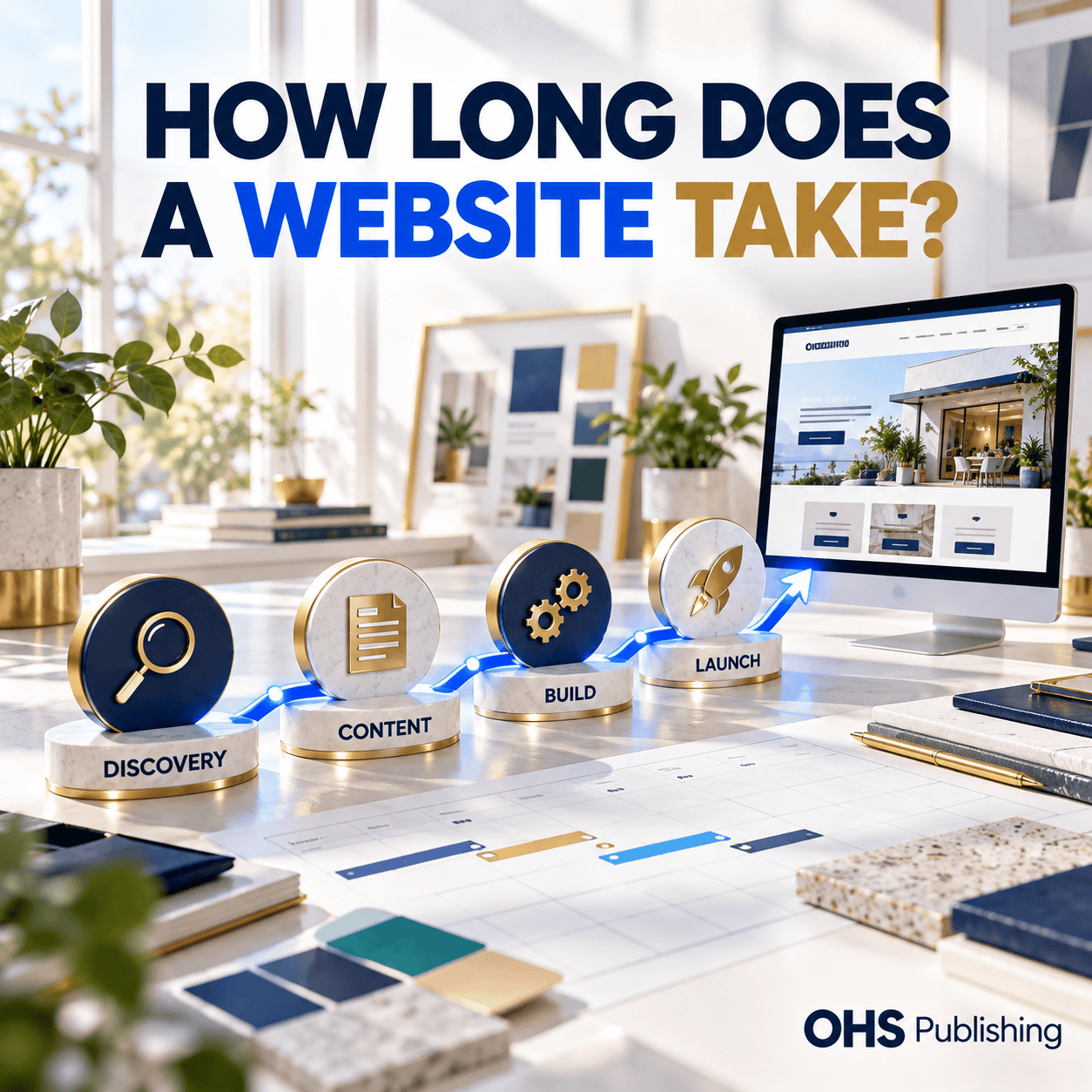
Before choosing a path, estimate the hours required for planning, writing, building, reviewing, testing, and correcting. Then decide when those hours will actually happen. Our guide to small-business website timelines explains why scope and readiness usually matter more than a promised number of days.
Do not overlook ownership and portability
Before building or hiring, ask who controls the domain, hosting account, website files, analytics, forms, and connected services. The business should know where each account lives and who can access it.
Some hosted builders make setup easy by keeping everything inside one platform. That convenience can limit what moves if the business later changes systems. WordPress provides more flexibility, but that flexibility also brings responsibility for hosting, updates, backups, and plugin compatibility. OHS Publishing's WordPress web design page outlines the platform approach used for business websites.
If you hire a designer, the proposal should explain deliverables, third-party costs, ownership, launch responsibilities, and ongoing support. If you build it yourself, keep account access in a business-controlled password manager and document every paid tool connected to the site.
Plan for the work after launch
No website stays finished. Business details change. Plugins and platforms are updated. New questions appear in sales conversations. Pages need refinement, backups need checking, and forms should be tested periodically.
DIY owners should schedule routine reviews and decide who will respond when something breaks. Businesses hiring a designer should ask whether support is included, available separately, or handed back entirely after launch. A website maintenance plan can be useful when the team wants ongoing technical attention and a clear contact for changes.
Use a hybrid approach when it fits
The choice does not have to be completely DIY or completely outsourced. A business can hire a professional to plan the structure and set up a reliable system, then manage routine text and photo updates internally. Another owner may build a small first version, prove the offer, and hire help when the site must support more traffic, services, or locations.
A hybrid approach works when responsibilities are clear. Decide who owns strategy, content, design, technical setup, launch testing, and maintenance. Paying for a few hours of targeted help can be more effective than struggling alone or purchasing a larger package than the business needs.
A practical decision checklist
Building your own website is more likely to work when the site is small, the features are standard, the owner has time to learn, and the business can tolerate a gradual launch. Hiring a web designer is more likely to pay off when the site supports meaningful revenue, competes for search traffic, connects to operations, or replaces an established site.
Before deciding, answer these questions:
- Can I describe the required pages and features in writing?
- Do I have time to write, build, test, and maintain the site?
- Will a weak page structure make it harder to rank or generate leads?
- Does the current site contain URLs or data that must be protected?
- What is the business cost of a delayed launch or a broken feature?
- Who will be responsible for the site six months after launch?
If the answers point toward professional help, look for a proposal that connects the work to the business requirements. OHS Publishing's Kansas City web design service is built around clear pages, practical contact paths, WordPress, and a foundation the business can keep using after launch.
Frequently asked questions
Is a DIY website good enough for a small business?
It can be. A DIY website can work well when the offer is simple, the site is small, the features are standard, and the owner has time to build and maintain it carefully. The site still needs clear content, mobile-friendly pages, working forms, accurate contact information, and a plan for updates.
When should I hire a web designer?
Hire a web designer when the website must generate qualified leads, compete in search, handle important transactions, connect to business systems, or replace an established site with search history and existing traffic. Professional help is also practical when your time is better spent running the business.
Can I build the website myself and hire help later?
Yes. Start with a focused version and keep control of the domain, content, accounts, and brand assets. Document the tools you use and avoid a structure that depends on unnecessary plugins or custom work you cannot maintain. A professional can then improve or rebuild the site when the business requirements become clearer.
What should I ask a web designer before hiring?
Ask what is included, which costs renew, who owns the domain and website, how content and SEO are handled, what testing happens before launch, what support is available afterward, and how changes outside the original scope are priced. The answers should be written into the proposal or agreement.
Choose the path that supports the business
A website builder can give a capable owner a fast, affordable starting point. A professional designer can reduce technical risk, organize a stronger customer journey, and build around more demanding goals. Neither option is automatically right for every business.
Define the job, compare the complete cost, account for your time, and decide who will care for the site after launch. If you want a clear opinion on what your business actually needs, OHS Publishing can review the scope and help you choose a practical path without adding features simply to make the project larger.