What Google Looks for When Ranking Local Businesses
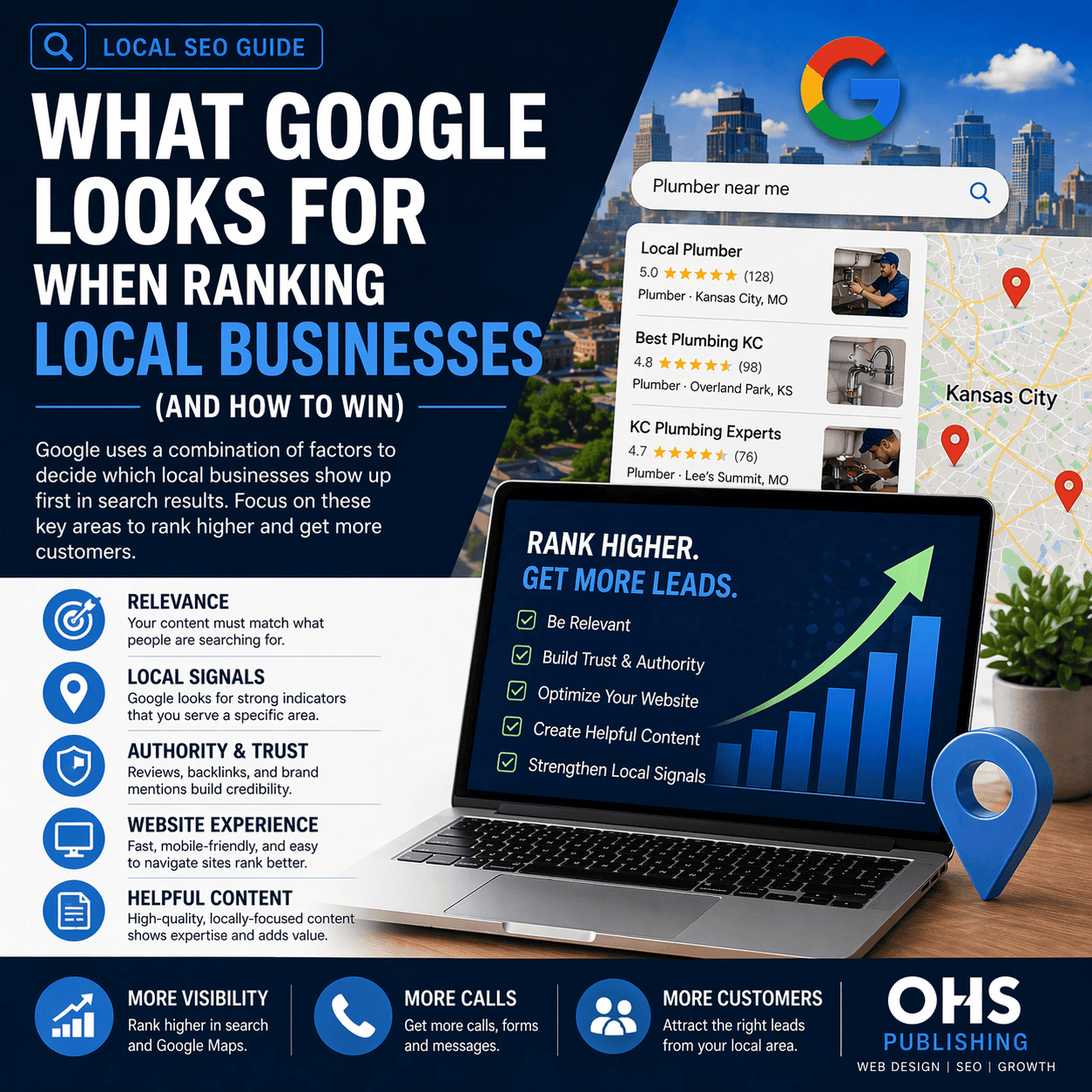
Local search can introduce your business to people who are ready to call, compare providers, or request an estimate. But a higher position is not something a designer can switch on with a new color scheme, a plugin score, or a page filled with city names. A useful local SEO plan starts by distinguishing the places your business can appear, checking that your information is accurate, and improving the pages that help customers make decisions.
For Kansas City businesses, this matters because serving a broad metro area does not make every nearby search identical. A person looking for a contractor in Liberty may see different results from someone looking in Overland Park. The service, the searcher's location, and the businesses competing for that search all matter. This guide explains what to review and how to turn that review into a manageable improvement plan.
Separate Google Maps visibility from website visibility
A local search may show a map with business listings, ordinary website results, advertisements, and other search features. These are different opportunities. Your Google Business Profile supplies information for your business listing, while your website contains the service pages, articles, contact details, and evidence customers can explore in more depth. Work on both, but do not assume that improving one automatically produces the same result in the other.
When someone says that a business does not rank, ask for the exact search and the result they mean. Are they looking for the business name or a general service? Are they checking the map or the ordinary search results? Where are they searching from? Those questions turn an imprecise complaint into something you can investigate. They also prevent unnecessary redesign work when the actual issue is an incomplete or inaccurate business listing.
Understand the factors Google publicly describes
Google's local ranking guidance describes relevance, distance, and popularity as its main local ranking factors. It also states that businesses cannot request or pay for a better local ranking. Treat that as a useful boundary for evaluating marketing promises: an agency can improve your information and website, but it cannot sell control over Google's local results.
In practice, begin with the factors you can meaningfully review. Check whether your description of the business matches your actual services. Make sure customers can understand where you operate. Look for credible evidence of your work and a consistent way to keep business information current. A report should explain the changes made and the outcomes observed, rather than presenting a proprietary score as proof that Google will reward the business.
Make your business information accurate and usable
Review the business name, phone number, website link, hours, services, and customer-facing location information together. Ask a staff member who handles inquiries to compare the published details with what the business actually does. Old hours, a disconnected number, or a link to a retired page can lose an opportunity even when the listing receives attention. Accuracy is therefore a customer-service task as well as a search task.
Distinguish an office that receives customers from a mailing address and from a service area. Explain these differences honestly on the website. If appointments are required, make that clear. If your team travels to customers, describe the actual coverage and any limitations. Do not invent a branch location to make a page seem more local. Customers should know what will happen when they contact the business or visit the address shown.
Build service pages around real buying questions
A useful service page should help a person decide whether to continue the conversation. Explain what the service includes, who it is for, what information is needed to prepare an estimate, and how the process usually starts. Include important exclusions when they prevent a misunderstanding. A contractor, for example, may offer replacement work but not every type of repair. Saying so helps the customer and the person answering the phone.
Organize each page around a distinct service rather than repeating a broad company description under different headings. If two pages answer the same question for the same audience, decide which one should be the main resource. Our Kansas City SEO services page explains the broader role of content and site structure, while a detailed service page should focus on its particular customer need. Clear roles make the site easier to maintain.
Use location pages only where they add useful information
A city page is worthwhile when it helps a customer understand how the service applies in that area. Relevant information might include actual coverage, a completed project used with permission, the kind of properties served, or the process for scheduling work there. The useful detail depends on the business. A page does not become helpful simply because it mentions a town in the headline and repeats a list of nearby communities.
Start with a small number of markets you genuinely serve and can support with meaningful content. Build a clear service-area overview, then link to individual pages where there is enough information to justify them. For a fuller planning method, read our guide to serving multiple cities without repetitive location pages. The goal is a coherent customer journey, with a reason for every page to exist.
Show evidence customers can evaluate
Specific evidence is more useful than repeatedly calling your business the best. Show relevant projects, describe the work completed, identify the people responsible, and explain your process. Use photographs you have permission to publish. If a credential or professional membership is relevant, check that it is current before displaying it. A visitor should be able to connect the evidence to the service they are considering.
Reviews and testimonials should represent real experiences and follow the rules of the platform where they are collected or displayed. Avoid editing a quotation in a way that changes its meaning. Do not turn one successful project into a promise about every customer's outcome. A thoughtful case study can explain the starting problem, what changed, and what was observed while acknowledging limits. That is more credible than an unsupported claim about guaranteed growth.
Make the mobile experience easy to complete
Open your key service page on a phone and try the same task a new customer would attempt. Read the introduction, open the menu, find the coverage area, and reach the contact form. Check whether text fits, buttons have room around them, and the form makes sense without zooming. A beautiful desktop design can still make an ordinary inquiry frustrating on a small screen.
Use a clear heading hierarchy, readable contrast, descriptive links, and visible field labels. Keep decorative motion from interrupting the main task. Check that useful information is not hidden behind an element that fails to open. These are practical usability improvements; avoid treating any single visual change as a guaranteed ranking improvement. Our WordPress web design approach connects structure and presentation so visitors can move from learning about a service to contacting the business.
Connect related pages with descriptive internal links
Internal links should answer the reader's next question. An article about planning a website can link to a design service page. A service page can link to a relevant project example. A coverage overview can link to the cities it describes. Use link text that tells the reader what they will find, rather than repeating vague phrases such as click here throughout the article.
Do not add a large block of unrelated links solely because the pages contain valuable keywords. Review links in context and remove ones that lead to retired, misleading, or irrelevant destinations. Keep navigation understandable for people who have never visited the site. A modest network of useful connections is easier to manage than a sprawling set of near-identical pages that all point to one another without a clear purpose.
Check indexing and technical basics before writing more
Before adding another article, confirm that important pages can be found through the site and are intended to appear in search. Review unexpected redirects, broken links, accidental noindex settings, and mismatches between the page you want visitors to see and its canonical URL. If these settings are unfamiliar, ask the person responsible for the website to document them. Changing them without understanding the existing structure can create new problems.
Google's SEO Starter Guide is a useful reference for basic search practices. A practical maintenance review should also cover working forms, image loading, secure connections, and the behavior of menus and buttons after updates. Separate an urgent functional defect from an optional design enhancement so your team can fix the issues that interfere with customers first.
Use schema and Yoast as supporting tools
Structured data describes information about a page or business in a machine-readable format. For an article, that can include its title, author, publication details, and publisher. Keep the information consistent with the visible page and the actual business. If you include FAQ markup, the questions and answers should also appear for readers. Avoid adding unsupported ratings, locations, credentials, or services to make the markup look more impressive.
Yoast can help manage titles, descriptions, canonical settings, and common checks. Its analysis is an editing aid, not a statement from Google about where your page will rank. A green indicator does not prove that the content is accurate or useful. Review the page as a customer would, then use the plugin to catch omissions. Do not force awkward repetitions into an otherwise clear paragraph just to change a colored score.
Measure inquiries and lead quality alongside visibility
Choose a small set of outcomes that matter to the business. These might include completed quote requests, calls that become qualified inquiries, booked consultations, or sales conversations for the services you want to grow. Define what counts before comparing periods. A button click and a successful submission are different events, and a spam message should not be celebrated as a new customer opportunity.
Review search information and business outcomes together. If a page receives attention but few suitable inquiries, examine its offer, geographic fit, and contact process. If inquiries increase but staff cannot respond promptly, the next improvement may be operational. Keep notes about major website changes, seasonal conditions, and other campaigns so you do not automatically attribute every movement to the last SEO edit.
Create a realistic sequence of improvements
Begin by repairing inaccurate information and broken contact paths. Next, strengthen the pages for your core services, including clear explanations and relevant evidence. Then review location coverage, supporting articles, and internal links. This sequence gives the business useful foundations before expanding the archive. Assign a responsible person to each change and keep a short record of what was updated and why.
After the changes are live, allow time to collect meaningful observations and keep maintaining the site. Search visibility is not a one-time setting, but that does not mean every page needs constant rewriting. Update details when they change and improve content when you identify a real unanswered question. If you want help prioritizing, request a website and SEO review from OHS Publishing with your URL, main services, coverage area, and the outcomes you want to improve.
Evaluate an SEO proposal by its specific work
A useful proposal should identify the pages or systems that need attention, explain the intended changes, and describe how progress will be reported. Ask whether the work includes reviewing existing content, repairing links, improving contact flows, or maintaining business information. Clarify who supplies photographs, approves business claims, and handles ongoing updates. These details help you compare proposals that might otherwise look similar on the surface.
Also ask how the provider distinguishes observations from assumptions. A ranking screenshot taken from one location is a snapshot, not a complete picture of the market. A traffic increase is not automatically a revenue increase. The strongest working relationship gives you an understandable record of actions, limitations, and results. That lets you make informed decisions about the next improvement instead of relying on a promise that nobody can verify.
Frequently asked questions
Can a web designer guarantee the top local ranking?
No. A designer or SEO provider can improve your website and business information, but cannot control Google results or guarantee a position. Ask for a clear scope of work and reporting tied to meaningful business outcomes.
Does a new website automatically improve Google Maps rankings?
No. Website improvements and Google Business Profile work serve related but different purposes. Review the specific search result, the accuracy of your listing, and the quality of the relevant website page.
Should every city have its own page?
Only when a separate page gives customers useful information about a location you actually serve. A clear service-area overview may be more useful than many pages that repeat the same text.
Does a green Yoast score mean a page will rank?
No. Yoast checks can highlight editing opportunities, but they are not Google rankings or guarantees. Accuracy, usefulness, clear structure, and a working customer journey still need human review.
What should a local SEO report include?
Include the changes completed, the pages affected, relevant search observations, and business outcomes such as qualified inquiries. Explain measurement limits and distinguish successful submissions from clicks or spam.
How often should business information be reviewed?
Review it whenever services, staff, coverage, contact details, or hours change. Add a routine check so outdated information and broken contact links are discovered before customers depend on them.