Does SEO Impact Brand Authority? How Visibility, Trust, and Recognition Work Together
SEO can influence brand authority, but not because Google assigns every company one public “brand authority” score. The relationship is more practical. When a business consistently appears for useful searches, publishes credible information, earns relevant mentions, maintains accurate local signals, and provides a trustworthy website experience, more people discover and recognize the brand.
That recognition can lead to more branded searches, direct visits, referrals, reviews, links, repeat visitors, and customer confidence. Those outcomes do not all operate as simple ranking factors, but together they can create a stronger online presence and support better organic performance.
Effective Kansas City SEO therefore should not chase rankings in isolation. It should strengthen the pages customers find, demonstrate real expertise, remove reasons to distrust the site, and help the business become a more visible resource in its market.
What Does Brand Authority Mean?
Brand authority is the degree to which customers, peers, publishers, and other organizations recognize a business as credible and knowledgeable in its field. It is a marketing concept rather than one universal number.
An authoritative brand is easier to identify, easier to trust, and more likely to be considered when someone needs the service or product it provides. That authority may come from experience, proven work, customer satisfaction, original insight, media coverage, professional credentials, community involvement, consistent content, or a combination of these.
Online authority is expressed through many signals rather than a single metric:
- People search for the business by name or return directly to its website.
- Relevant websites mention or link to the brand and its resources.
- Customers leave detailed reviews and recommend the business.
- The website covers its core services and subject matter with useful depth.
- Authors, team members, qualifications, and real-world experience are clear.
- Business information stays consistent across the website and local profiles.
- The brand earns recognition through projects, partnerships, associations, events, or community activity.
No single item proves authority by itself. A new company can have excellent content but limited recognition. An established company can be well known offline while presenting a weak or confusing website. SEO helps connect the business’s real credibility to the way it is discovered and understood online.
Brand Authority Is Not a Single Google Ranking Factor
It is tempting to describe brand authority as a direct ranking factor, but that oversimplifies how search works. Google uses many systems and signals to understand pages, relevance, quality, links, location, usability, and search intent. There is no public dashboard showing an official Google “brand authority” score that businesses can raise.
Third-party SEO platforms may calculate metrics such as domain authority, authority score, or domain rating. These can be useful for comparison and research, but they are estimates created by those companies—not Google scores. Raising a third-party metric should never become the campaign’s primary goal.
The better question is whether the website is becoming more useful, discoverable, trusted, and competitive for the searches that matter. Rankings, organic traffic, qualified inquiries, branded demand, strong referring links, local visibility, and engagement with priority pages give a more complete picture.
Where E-E-A-T Fits Into the Conversation
Experience, expertise, authoritativeness, and trustworthiness—often shortened to E‑E‑A‑T—provide a useful way to evaluate whether content feels credible and dependable. They should not be treated as four fields to fill in or a single score to optimize.
Experience can be demonstrated through firsthand knowledge, original examples, real projects, case studies, photographs, processes, and lessons learned. Expertise appears through accurate explanations and appropriate qualifications. Authoritativeness develops when a person, business, or website becomes recognized as a useful source. Trust depends on honesty, accuracy, security, transparency, and a reliable customer experience.
These qualities are especially important when content can affect someone’s health, finances, safety, or major life decisions, but every business benefits from making its identity and claims easier to verify.
Useful trust elements may include author information, an accurate About page, real contact details, service policies, source attribution when needed, updated content, secure forms, reviews, credentials, and a clear explanation of who is responsible for the website.
SEO Increases the Opportunities for a Brand to Be Discovered
A business cannot become familiar to searchers who never encounter it. SEO expands the number of relevant moments in which the brand can appear: a service search, local question, comparison, problem, definition, cost concern, or research topic.
That does not mean publishing a page for every possible keyword. Strong SEO identifies the services and questions most closely connected to the business, then builds useful pages around them. Each page should satisfy a real need while guiding the visitor toward a logical next step.
Repeated visibility can create familiarity. A homeowner may first find a how-to article, later see the company in local results, and eventually return by name when ready to request service. The first visit may not generate a lead, but it can begin the recognition that influences a later choice.
People-First Content Demonstrates Expertise
Authority grows when content genuinely helps the audience understand a subject or make a better decision. Thin articles written only to include keywords rarely achieve that. They may repeat common statements without adding examples, context, judgment, or a useful answer.
Strong content begins with the customer’s question and the business’s real knowledge. A contractor can explain warning signs, project decisions, materials, timelines, and maintenance. A healthcare practice can clarify treatment approaches, provider roles, appointment preparation, and patient resources. A professional firm can explain processes, risks, documents, costs, and common misunderstandings.
Ongoing blog and article writing can build topical depth when every piece supports a purposeful content system. Articles should connect to relevant service pages, related questions, author or team expertise, and the next step a reader may need.
Topical Depth Is More Valuable Than Random Posting
Publishing frequently does not automatically create authority. A website becomes more useful when it covers the subjects central to the business with enough depth and organization that visitors can continue learning.
A topic cluster may include a primary service page supported by detailed articles, FAQs, case studies, location content, comparison pages, and related resources. Internal links connect those pieces so visitors can move from broad information to a specific decision.
For example, an HVAC company might have a main air-conditioning service page supported by articles on warning signs, repair versus replacement, maintenance schedules, efficiency, strange sounds, and thermostat problems. The cluster demonstrates practical knowledge while giving search engines a clearer understanding of how the pages relate.
Internal links should be descriptive and useful. They are not an excuse to force the same keyword into every paragraph. A well-planned Kansas City website makes this content hierarchy clear through navigation, page structure, breadcrumbs, related resources, and purposeful calls to action.
Relevant Links and Mentions Can Strengthen Credibility
Links remain an important part of how the web connects information. When a relevant and reputable website chooses to cite a company, study, guide, tool, event, or resource, that link can help people discover the brand and provide search engines with context.
Quality matters more than chasing a large raw count. A local chamber, trade association, respected industry publisher, community partner, supplier, university, news outlet, or client case study may provide a meaningful connection. Hundreds of irrelevant directory or spam links can create noise and risk without building real recognition.
The most sustainable link strategy is usually tied to something worth referencing: original research, a useful guide, a community resource, expert commentary, a strong project, a tool, a partnership, or newsworthy business activity.
Unlinked mentions can still introduce people to a brand even when they do not pass through as website traffic. They are valuable from a marketing standpoint because recognition exists beyond the link itself.
Reviews Build Human Trust and Local Visibility
Reviews influence how potential customers evaluate a business, especially in local search. The number of reviews alone is not the full story. Recency, detail, consistency, owner responses, platform, and the experiences described all shape credibility.
A strong review process asks real customers for honest feedback at an appropriate point in the relationship. Businesses should never manufacture reviews, exchange incentives in ways that violate platform rules, or pressure customers to leave only positive feedback.
Responses also matter. Thanking customers, addressing concerns professionally, and avoiding defensive or revealing replies show how the business handles relationships. Reviews should connect with the same services, locations, and brand experience presented on the website and Google Business Profile.
Branded Search Shows Recognition—but Needs Context
Branded searches include the company name, product name, founder, location, or another term specifically associated with the business. Growth in branded search can indicate that more people know the brand or are returning after an earlier interaction.
However, branded search volume is not a complete authority score. It can change because of advertising, news, seasonal demand, offline marketing, social activity, public relations, controversy, or a similarly named business. It should be interpreted alongside direct traffic, conversions, customer inquiries, local visibility, and other data.
Businesses should also protect the experience around branded searches. The website title, site name, business listings, social profiles, reviews, and contact information should make it easy for searchers to confirm they found the correct company.
Social Media Supports Recognition More Than Direct Rankings
Social activity can expand the reach of useful content, introduce the people behind the business, generate conversation, support customer relationships, and send visitors to the website. Those benefits can strengthen awareness and create opportunities for links or mentions.
It is less accurate to promise that likes, shares, or follower counts directly raise Google rankings. Social performance and search performance should be measured for the roles they actually play. A connected social media marketing strategy can amplify expertise and brand personality while the website remains the primary home for durable service and educational content.
Technical Quality and User Experience Affect Trust
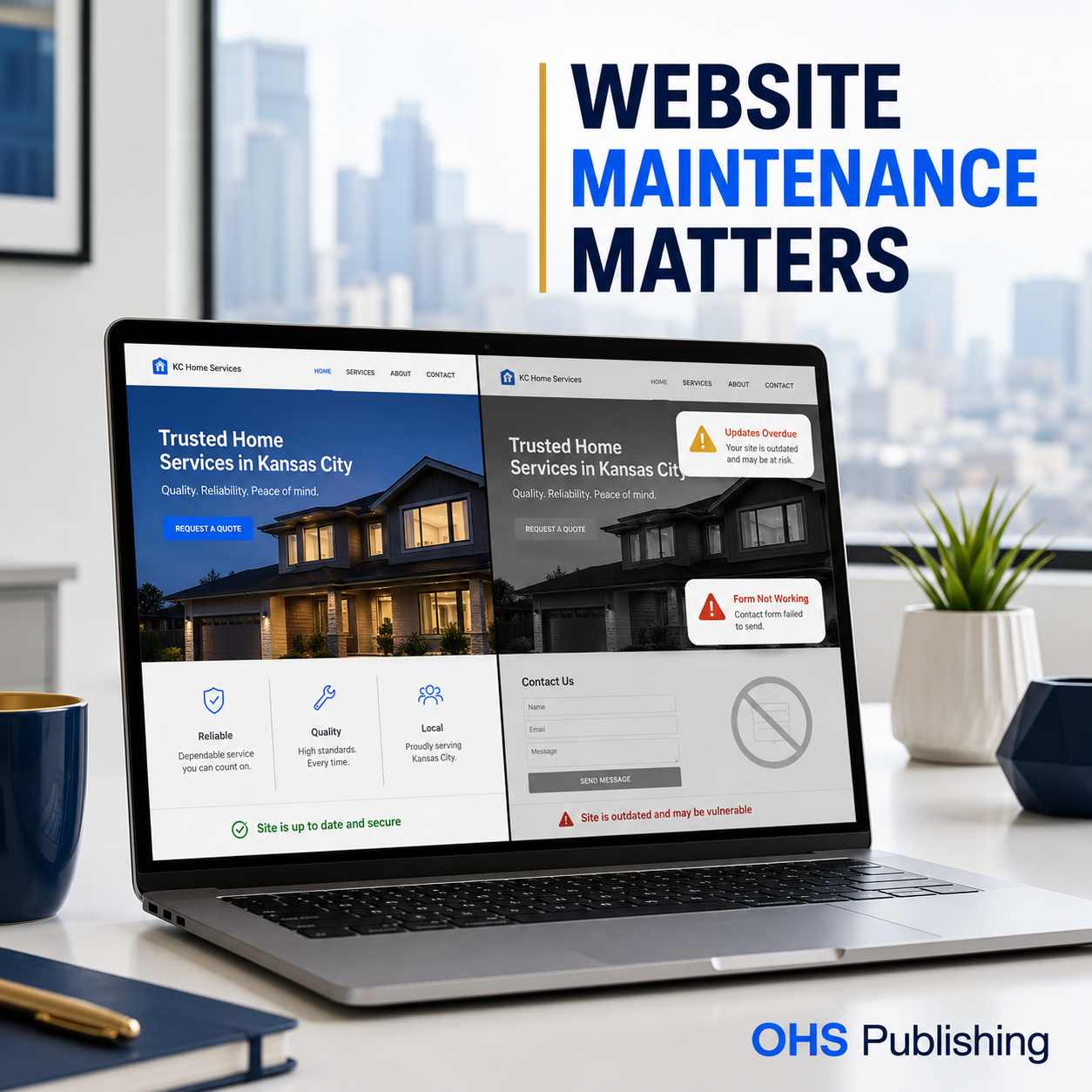
Authority can be undermined by a website that feels neglected. Security warnings, broken forms, outdated staff information, intrusive popups, missing contact details, slow pages, confusing navigation, and poor mobile layouts create doubt even when the underlying business is excellent.
Technical SEO and user experience help remove those barriers. Important pages should be crawlable, indexable, clearly titled, internally connected, and functional across devices. Structured data can provide explicit information about an organization, article, service, FAQ, or local business when it accurately matches visible content.
Regular website maintenance protects this foundation through updates, security attention, monitoring, and ongoing support. A credible brand should not be represented by a site no one is responsible for maintaining.
Local Consistency Helps Searchers Verify the Business
For a Kansas City business, authority is tied to place as well as subject. Searchers want to know where the company is located, which communities it serves, when it is open, and how to contact it.
The business name, address, phone number, hours, categories, service areas, and website should be accurate across major profiles. The website should explain the real geographic market without creating thin pages that merely swap city names.
Useful local content can discuss services in the context of the community, show relevant work, answer location-specific questions, and connect regional pages logically. OHS Publishing’s locations served structure shows how city and county pages can support a broader Kansas City presence without hiding the core services.
How to Measure SEO and Brand Authority Together
No single metric tells the entire story. Use a group of indicators tied to visibility, recognition, trust, and business outcomes.
- Non-branded organic visibility: Are priority service and informational pages appearing for relevant searches?
- Branded search and direct visits: Are more people looking for or returning to the company specifically?
- Qualified organic conversions: Are search visitors calling, booking, purchasing, or requesting quotes?
- Referring domains and mentions: Is the business earning relevant recognition from credible sources?
- Review quality and velocity: Are real customers regularly describing useful, trustworthy experiences?
- Content engagement: Do visitors reach related services, resources, case studies, and calls to action?
- Local performance: Is visibility improving for the locations and services most important to the business?
- Lead quality: Are inquiries increasingly aligned with the work the company wants to win?
Track trends over time rather than overreacting to one week of movement. Rankings vary by location, device, competition, and search context. The goal is steady improvement in the market visibility and customer actions that matter.
What Weakens Brand Authority Online?
Authority is easier to damage than many businesses realize. Shortcuts may create activity without building trust.
- Publishing mass-produced articles that repeat existing information without expertise or review.
- Creating thin city pages with nearly identical text and no local usefulness.
- Buying irrelevant links, participating in obvious link schemes, or filling low-quality directories.
- Using fake reviews, fabricated credentials, vague case studies, or claims that cannot be supported.
- Allowing outdated staff, services, pricing, hours, or contact information to remain online.
- Hiding who created the content or who is responsible for the business.
- Prioritizing keyword repetition over clarity and a useful customer experience.
- Ignoring website security, performance, mobile usability, and broken conversion paths.
Sustainable authority comes from aligning the online presentation with the real quality of the company. SEO should make genuine value easier to discover—not manufacture a reputation the business has not earned.
A Practical SEO Plan for Building Authority
Start with the website and the customer journey. Make sure the business identity, services, locations, proof, people, and next steps are clear. Fix technical problems that limit crawling, indexing, usability, or conversions.
Next, identify the service pages and topic clusters most closely tied to growth. Strengthen thin pages before publishing large amounts of new content. Add firsthand examples, useful FAQs, project proof, author context, and internal links where they help the reader.
Then build recognition beyond the website through customer reviews, community relationships, industry participation, partnerships, public relations, useful resources, and responsible social distribution. Measure search performance and business outcomes together.
If you are not sure where the biggest gaps are, begin with the OHS Publishing free Website and SEO Audit. It reviews site structure, service pages, local relevance, content, trust signals, internal linking, and lead-generation opportunities so the next steps can be prioritized.
Frequently Asked Questions About SEO and Brand Authority
Is brand authority a direct Google ranking factor?
Google does not provide one public brand-authority score that directly determines rankings. Search performance is influenced by many systems and signals. Brand recognition, useful content, relevant links, reviews, local consistency, and a trustworthy website can support visibility and customer confidence, but they should not be reduced to one authority metric.
What is the difference between brand authority and domain authority?
Brand authority is a broad marketing concept describing how credible and recognized a business is. Domain authority and similar scores are estimates created by third-party SEO platforms to compare websites. Those scores can be useful for research, but they are not official Google metrics and should not replace business-focused SEO measurement.
Does publishing more blog posts automatically build authority?
No. Publishing more pages helps only when the content is useful, accurate, relevant to the business, and organized around real customer needs. A smaller collection of strong service pages, articles, case studies, and FAQs can create more value than frequent thin posts with no original expertise or clear purpose.
Do social media mentions improve SEO rankings?
Social mentions can increase awareness, distribute content, generate referral traffic, and create opportunities for links or further coverage. It is not accurate to promise that likes, shares, or follower counts directly improve Google rankings. Social and SEO support different parts of a connected visibility strategy.
How long does it take to build brand authority through SEO?
Authority and organic visibility usually develop over time. The pace depends on the starting website, competition, market, existing reputation, content quality, technical health, links, reviews, and consistency of the work. Early improvements may appear sooner, but meaningful recognition generally requires sustained effort rather than a one-time optimization.
Use SEO to Become Easier to Find—and Easier to Trust
SEO impacts brand authority most effectively when it helps real expertise become visible. Strong pages answer the right questions. Clear business information builds confidence. Relevant links and reviews provide outside validation. Technical quality protects the experience. Consistent content gives customers more reasons to recognize and return to the brand.
OHS Publishing helps Kansas City businesses connect website structure, useful content, local relevance, technical improvements, and conversion strategy into a clearer organic growth plan. Explore our Kansas City SEO services, or request an SEO quote to discuss the services, locations, and opportunities most important to your business.